
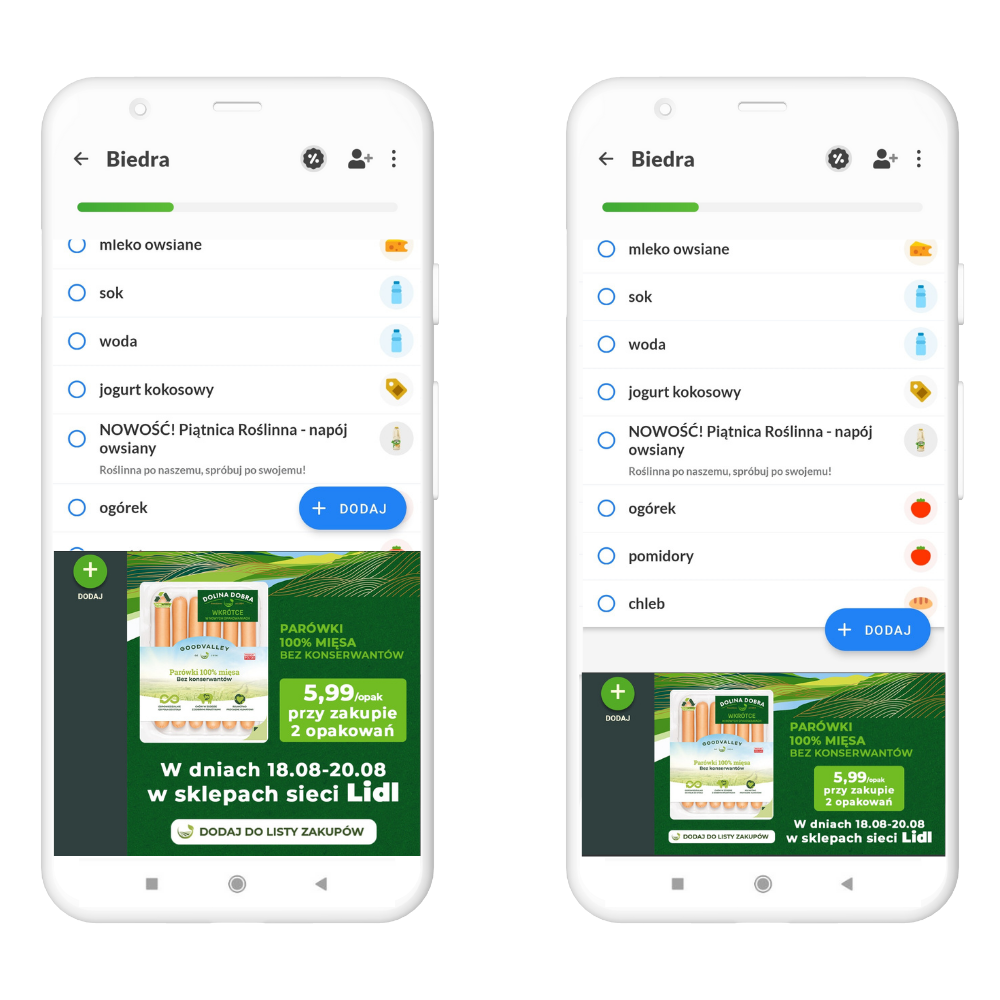
Shopper marketing and trade marketing are often used interchangeably. In practice, they differ in goals, audience, and the way they influence sales. Understanding the difference is especially important in modern channels such as shopping apps, e-commerce, and retail media.
Shopper marketing: marketing for the buyer
Shopper marketing focuses on a key moment: the purchase decision. Its goal is to influence behavior just before and during product choice. It is not only about broad brand awareness, but about making the shopper choose a specific product in a specific place and moment.
This approach recognizes that the consumer and the shopper are not always the same person. For example, a parent may buy snacks for a child. The child consumes the product, but the parent makes the purchase decision.
Examples of shopper marketing include POS materials, retail media placements in shopping apps, e-commerce coupons, and messages such as "add to basket" or "today only".
Trade marketing: sales support in the distribution channel
Trade marketing is aimed not directly at the final consumer, but at sales channels: retail chains, wholesalers, distributors, and commercial partners. Its goal is to make the product available, visible, and supported by the retailer.
Trade marketing makes sure the product reaches the store and receives the right exposure. Shopper marketing makes sure the buyer chooses it.
Examples include negotiations around promotional brochure space, retailer programs, displays provided to the chain, listing support, and promotional mechanics such as multi-buy offers.
Key differences
| Area | Shopper marketing | Trade marketing |
|---|---|---|
| Main audience | The shopper | The retail or distribution partner |
| Goal | Influence choice at the purchase moment | Secure trade terms and exposure that support sales |
| Perspective | Needs, barriers, and motivations of the shopper | Retailer terms, rules, negotiations, and margin |
| Point of sale | Designs the shopper experience and purchase trigger | Secures shelf, placement, POS approval, and exposure conditions |
| Main actions | POS communication, activation, shopping-app ads, retail media | Trade promotions, listings, bundles, retail negotiations |
| Metrics | Conversion, share of basket, shopper response | Sell-in, sell-out, execution, promotional efficiency |
| Time horizon | Short and medium-term activity around behavior | Often longer plans tied to retailer cooperation |
Why the distinction matters
Campaigns often combine both approaches, but they work better when the goal and audience are clear. If you want a new product to be included in a retailer brochure, you are working in trade marketing. If you want a user to add that product to a shopping list in an app, you are in shopper marketing.
Retail media connects the two worlds. It allows precise communication with shoppers, while also supporting retailer promotions and commercial priorities.
Summary
Shopper marketing and trade marketing have different perspectives, but they complement each other. One works at the level of the buyer's decision. The other works at the level of retailer cooperation. Understanding the distinction is a foundation for a stronger retail media and grocery marketing strategy.